Power Cuts in Kerala: Can Solar Work After Sunset?
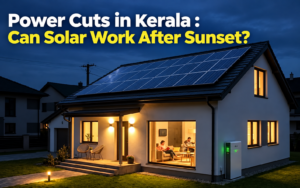
Power cuts in Kerala have become a growing concern in September 2026, especially during evening and night hours. For homeowners and businesses considering rooftop solar, this has raised an important question: Can solar panels provide electricity during a power cut after sunset?
The answer depends on the type of solar system.
Solar panels generate electricity when sunlight is available. After sunset, solar generation stops. A conventional grid connected solar system therefore cannot automatically provide backup when the grid goes down.
However, a properly designed solar and battery storage system can store energy during the day and make it available later.
Understanding this difference is important for anyone considering solar, battery backup or energy management solutions in Kerala.
What Is Happening With Power Cuts in Kerala?
The recent power cuts in Kerala are linked to a combination of high electricity demand and supply constraints.
During September 2026, Kerala’s electricity demand has remained unusually high. Recent reports put average September demand at around 5,000 MW, significantly above the corresponding period in 2025. Evening demand has also crossed the 5,000 MW level on some days.
On September 10, reported demand reached 5,024 MW at 6:44 pm, while demand remained high until around 2 am.
Several factors are contributing to the situation, including increased electricity consumption, cooling demand, EV charging, reduced availability from some generating sources and wider power supply constraints.
Kerala’s Electricity Minister has also highlighted increased use of air conditioners, fans and electric vehicles and discussed expanding solar generation and battery energy storage.
The important point is timing.
Electricity demand can remain high after sunset, when rooftop solar generation has already fallen or stopped.
Why Are Power Cuts in Kerala More Important After Sunset?
Electricity demand changes throughout the day.
During daylight hours, rooftop solar can contribute electricity to a property. Depending on the system and applicable grid arrangement, surplus electricity may also be exported to the grid.
After sunset, however, solar generation stops while electricity demand can remain high.
Homes may be using:
-
Fans and air conditioners
-
Lighting
-
Refrigerators
-
Kitchen appliances
-
Water pumps
-
Televisions and other electronics
Businesses may also continue operating in the evening. EV owners may charge their vehicles after returning home.
This creates a basic mismatch.
Solar generation is available during the day, while electricity demand can remain high during the evening and night.
Recent reporting indicates that Kerala’s peak demand is also continuing later into the night than before.
This is one reason battery storage is receiving greater attention.
Can Solar Panels Work During a Power Cut in Kerala?
This is one of the most common questions from solar customers.
A standard on grid solar system generally does not continue supplying electricity during a grid outage.
When the grid goes down, the solar inverter normally disconnects the system from the grid. This is an important safety feature that prevents electricity from being fed into a circuit that utility workers may be working on.
Therefore:
Solar panels do not automatically mean backup power.
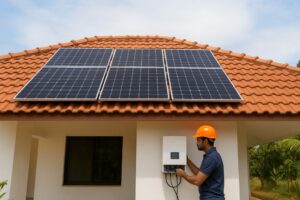
If you want electricity during a KSEB power cut, the system needs suitable backup equipment. This normally includes a compatible hybrid inverter and battery storage.
Why Doesn’t Rooftop Solar Work After Sunset?
The reason is simple.
Solar panels need sunlight to generate electricity.
During the day:
Sunlight → Solar panels → Inverter → Electrical loads
After sunset:
No sunlight → No solar generation
However, electricity generated during the day can still be used later if it has been stored.
This is the role of a solar battery.
The basic process is:
Solar generation → Battery charging → Sunset → Stored energy → Selected loads
This makes solar battery backup particularly relevant for consumers who want protection against night time power cuts in Kerala.
How Can Solar Battery Storage Help During Power Cuts?
A battery allows electricity generated during the day to be stored for later use.
When solar production is higher than the property’s immediate requirement, the system can use available energy to charge the battery.
After sunset, stored energy can supply selected loads.
During a grid outage, a properly configured hybrid system can provide backup to designated circuits.
However, a battery does not provide unlimited electricity.
Backup duration depends on:
-
Battery capacity
-
Usable battery capacity
-
Inverter capacity
-
Connected electrical loads
-
Battery charge level
-
Duration of the outage
For example, a battery supplying lights, fans, WiFi and essential electronics can last much longer than one powering several air conditioners, water heaters and an EV charger.
Therefore, battery sizing should begin with the customer’s actual backup requirements.
Is Solar and Battery Storage Worth Considering in Kerala?
There is no single answer for every property.
For some customers, an on grid rooftop solar system may be sufficient if the main objective is reducing electricity purchases from the grid.
For others, backup during power cuts may be equally important. In such cases, battery storage can be considered.
The decision should take several factors into account.
Electricity consumption
A small home and a large villa have very different energy requirements.
Backup requirement
Consider which appliances need to remain operational during an outage.
Load profile
Understanding when electricity is consumed is important. A property with high daytime consumption will have different storage requirements from one with heavy evening consumption.
Solar capacity
The solar system should be appropriately sized for daytime consumption and, where required, battery charging.
Battery capacity
Battery capacity should be based on the required backup duration and the loads that need to operate.
Budget
Battery storage increases the initial cost of a solar installation. Its value should therefore be assessed against the customer’s actual backup requirements.
Solar Battery Backup for Homes and Businesses
The need for backup differs from one property to another.
Homes and villas
A homeowner in Kochi, Ernakulam, Thrissur, Kottayam or another part of Kerala may want to keep lights, fans, refrigerators, WiFi and CCTV operating during a power cut.
Shops
Shops may need lighting, refrigeration, CCTV, billing systems and internet equipment.
Offices
Offices may prioritise computers, networking equipment, security systems and essential lighting.
Hotels and hospitals
These properties can have larger and more critical electrical loads. Backup planning may need to consider refrigeration, HVAC systems, pumps and essential equipment.
Industrial facilities
Industrial customers require a more detailed assessment of machinery, operating schedules, energy consumption and critical loads.
For businesses, the question should therefore go beyond:
“How many solar panels do we need?”
A better question is:
“When do we use electricity, which loads are important, and how can we generate, store and manage energy more effectively?”
What Should You Check Before Choosing Solar Battery Backup?
If you are considering a battery system because of power cuts in Kerala, do not compare solutions based only on price.
Check the following:
-
Solar panels: Technology, efficiency and warranty
-
Inverter: Whether it supports the required backup configuration
-
Battery: Chemistry, usable capacity, warranty and expected life
-
Backup loads: Which appliances will operate during an outage
-
Safety: Earthing, protection and proper installation
-
Monitoring: Solar generation, consumption and battery status
-
Installation: Cabling, mounting and system configuration
-
After sales service: Maintenance and technical support
-
Future expansion: EV charging and additional electrical loads
A professional assessment before installation can help prevent both undersizing and unnecessary investment.
What Do Power Cuts in Kerala Mean for the Future of Solar?
The current power cuts in Kerala highlight a broader change in how electricity needs to be managed.
For years, rooftop solar was mainly discussed as a way to reduce electricity bills.
That remains important.
But the current situation raises another question:
Can we generate electricity when sunlight is available, store it and use it when demand is higher?
Kerala’s government has been discussing both solar generation and battery energy storage as part of its response to changing electricity demand. A proposed solar and battery project at Brahmapuram in Ernakulam is among the initiatives reported in September 2026.
At the national level, rooftop solar adoption is also growing. MNRE reported 32.59 GW of grid connected rooftop solar capacity in India as of August 31, 2026.
The future of solar is therefore becoming about more than generation.
It is about:
Generate → Store → Manage → Use
GSL Energy Solutions: Beyond Solar Installation
Choosing solar is not simply about selecting panels and installing them on a roof.
The system should match how the property actually consumes electricity.
GSL Energy Solutions approaches renewable energy as part of a broader energy management strategy, combining solar solutions with energy assessment, monitoring and system planning.
For homeowners, this can mean understanding electricity consumption and backup requirements before deciding whether battery storage is appropriate.
For commercial and industrial customers across Kerala, the assessment can include operating schedules, major loads, energy consumption patterns, solar capacity, storage requirements and monitoring.
The objective is to design an energy system around the property’s actual requirements.
Conclusion
The current power cuts in Kerala have highlighted an important limitation of rooftop solar.
Solar panels generate electricity during daylight hours. They do not continue generating after sunset.
If you want solar energy to support your home or business after sunset or during a grid outage, you need the appropriate combination of battery storage, backup equipment and energy management.
The right solution depends on your electricity consumption, critical loads, backup duration, solar capacity, battery requirement and budget.
The simplest way to understand the modern solar system is:
Solar generates.
Storage saves.
Energy management decides when to use it.
As Kerala’s electricity demand continues to evolve, this combination can become increasingly relevant for homes, businesses and industries looking for greater control over their energy use.