
How to Check KSEB Solar Feasibility in Kerala Before Installing Solar
If you are planning to install rooftop solar in Kerala, one of the first things you should check is whether your local electricity network can accommodate the proposed solar system.
Knowing how to check KSEB solar feasibility in Kerala can help you understand the available capacity in your area before you finalise your solar system.
KSEB provides an online DTR Capacity facility where consumers can view transformer wise renewable energy capacity, including feasibility issued, grid-connected capacity and balance available.
But what exactly should you check, and does the online information mean your solar system is automatically approved?
Let’s understand the process step by step.
What Is KSEB Solar Feasibility?
KSEB solar feasibility refers to the technical assessment of whether a proposed grid-connected solar system can be connected to the local electricity distribution network.
Your property may have:
-
Enough roof space
-
Good sunlight
-
Suitable roof orientation
-
Sufficient electricity consumption
But these factors alone do not confirm grid connectivity.
The local distribution transformer and network also need to have sufficient capacity for additional renewable energy connections.
KSEB’s rooftop solar process includes a Technical Feasibility Determination stage before the applicant proceeds to the next stages of registration and installation.
That is why learning how to check KSEB solar feasibility in Kerala is useful before investing in a grid-connected solar system.
How to Check KSEB Solar Feasibility in Kerala
KSEB provides a transformer wise renewable energy capacity checker through its Web Self Service portal.
Here is the basic process.
Step 1: Open the KSEB Web Self Service Portal
Visit the official KSEB Web Self Service portal.
Look for the DTR Capacity service under the available online services.
KSEB describes this service as a facility for viewing transformer wise renewable energy systems connected to the distribution network.
Step 2: Select Your District
On the DTR Capacity page, select the district where your KSEB electrical section office is located.
Make sure you select the correct district because the available transformer information is organised according to the electrical section.
Step 3: Select Your Electrical Section
Next, select the relevant KSEB Electrical Section.
If you are unsure which section serves your electricity connection, check your electricity bill or contact your local KSEB section office.
Step 4: Find the Relevant Transformer
After selecting the section, KSEB displays transformer wise renewable energy information.
The table includes columns such as:
-
Transformer Name
-
90% of DTR Capacity
-
Feasibility Issued
-
Grid Connected
-
Balance Available
The next step is understanding what these numbers mean.
What Does 90% of DTR Capacity Mean?
DTR stands for Distribution Transformer.
A transformer supplies electricity to consumers within a particular area.
KSEB’s DTR Capacity portal states that the cumulative capacity of distributed energy systems allowed to be interconnected with the distribution network cannot exceed 90% of the distribution transformer capacity, in accordance with Regulation 14(2) of the Kerala State Electricity Regulatory Commission Renewable Energy and Net Metering Regulations, 2020.
For example, if the applicable 90% capacity shown for a transformer is 100 kW, that figure is used as the renewable energy capacity limit for the published calculation.
This does not mean that every individual consumer can automatically install 100 kW.
Your individual solar application still needs to go through the applicable KSEB technical feasibility process.
What Does “Feasibility Issued” Mean?
The Feasibility Issued column indicates the capacity for which feasibility has been issued on that transformer.
It is different from the amount of solar that has actually been installed and connected.
That is why the KSEB table separately shows:
Feasibility Issued
and
Grid Connected
These numbers can be different.
What Does “Grid Connected” Mean?
The Grid Connected figure represents the renewable energy capacity already connected to the distribution network associated with that transformer.
This helps you understand how much of the available renewable energy capacity has already been utilised.
For someone researching how to check KSEB solar feasibility in Kerala, this is an important number to look at alongside the balance available.
What Does “Balance Available” Mean?
This is arguably the most important figure for someone planning rooftop solar.
Balance Available indicates the remaining renewable energy capacity shown as available for additional distributed-energy connections on the selected transformer.
For example:
| KSEB DTR Information | Example |
|---|---|
| 90% DTR Capacity | 100 kW |
| Feasibility Issued | 70 kW |
| Grid Connected | 65 kW |
| Balance Available | 30 kW |
These numbers are only an illustration.
If the portal shows a positive balance, it indicates that capacity remains under the published transformer level calculation.
If the portal shows 0 kW balance available, there is currently no remaining balance shown for additional distributed renewable-energy connections on that transformer.
However, this should not be treated as a guarantee or permanent rejection for every future application.
Does Checking KSEB Feasibility Online Guarantee Solar Approval?
No.
This is one of the most important points to understand.
The DTR Capacity page provides transformer level information. It does not replace the formal technical-feasibility assessment of your individual solar application.
KSEB’s rooftop solar process includes a specific Technical Feasibility Determination stage carried out after the application is submitted.
Therefore:
DTR capacity check = preliminary information
Formal KSEB technical feasibility = application specific assessment
You should consider both before proceeding with a grid-connected solar installation.
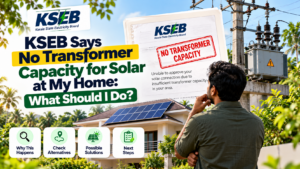
What If KSEB Shows 0 kW Balance Available?
If you check your transformer and find that the balance available is 0 kW, don’t immediately assume that solar is permanently impossible.
First, find out why the capacity is unavailable.
You can:
Check the correct transformer
Make sure you have identified the transformer serving your electricity connection.
Contact the KSEB section
Ask the concerned section whether the limitation is related to transformer capacity or another technical issue.
Ask about future network upgrades
Transformer augmentation or other network changes may affect available capacity in the future.
Discuss alternative system configurations
A qualified solar installer can assess whether a different system configuration may be appropriate for your electricity requirements.
However, you should not assume that reducing your solar capacity or installing a battery automatically bypasses KSEB requirements.
Can You Install Solar Without KSEB Feasibility?
If you are planning a grid-connected rooftop solar system, you should follow KSEB’s prescribed application and technical-feasibility process.
KSEB’s published rooftop solar procedure places technical feasibility before plant registration and installation. The process then continues through installation, project completion reporting, testing, agreement and meter installation.
Therefore, it is not advisable to install a grid-connected system first and try to obtain approval afterward.
Checking how to check KSEB solar feasibility in Kerala before installation can help you avoid this problem.
What Information Do You Need Before Checking Feasibility?
Before checking the KSEB DTR Capacity page, keep the following information ready:
-
KSEB consumer number
-
District
-
Electrical section
-
Property location
-
Proposed solar capacity
-
Existing connected load
The consumer number itself may not directly identify the transformer on the public DTR page, so if you cannot determine the correct transformer, contact KSEB or ask your solar installer to help identify it.
Why Should You Check Feasibility Before Choosing a Solar System?
Imagine you are planning a 5 kW rooftop solar system.
You select panels, inverter and mounting structure and pay an advance to an installer.
Later, you discover that the local network has no available renewable energy capacity.
This can create unnecessary delays.
Checking KSEB solar feasibility early helps you understand the network situation before finalising your project.
It also allows your solar installer to consider the feasibility result when discussing:
-
System capacity
-
Grid connection
-
Application process
-
Installation timeline
-
Metering requirements
-
Possible technical limitations
KSEB Solar Feasibility vs Roof Feasibility
These are two different things.
Roof feasibility
This determines whether your property is physically suitable for solar.
It considers:
-
Roof area
-
Shading
-
Roof direction
-
Structural condition
-
Panel layout
KSEB solar feasibility
This determines whether the proposed system can be connected to the electricity distribution network under the applicable technical requirements.
It considers factors related to:
-
Distribution transformer capacity
-
Existing renewable-energy connections
-
Network conditions
-
Proposed solar capacity
-
Applicable KSEB requirements
A good solar assessment should consider both.
What Happens After KSEB Technical Feasibility?
Once you submit the rooftop solar application, KSEB’s process moves through defined stages.
The published KSEB process includes:
-
Portal registration
-
Solar application
-
Application fee payment
-
Technical feasibility determination
-
Document submission
-
Registration
-
Solar installation
-
Project Completion Report
-
Testing
-
Test certificate
-
Agreement and meter installation
This means feasibility is an important step, but it is not the final step before your solar system becomes operational.
Frequently Asked Questions
How to check KSEB solar feasibility in Kerala?
You can use KSEB’s official Web Self Service DTR Capacity facility. Select your district and electrical section, then check the transformer wise renewable energy capacity and balance available.
Is KSEB solar feasibility available online?
Yes. KSEB provides transformer wise renewable energy capacity information through its Web Self Service portal.
What does 0 kW balance available mean?
It means the published renewable energy balance for that transformer has reached zero under the applicable capacity calculation. It does not by itself establish that solar can never be connected at that location.
Does positive balance mean my solar application will definitely be approved?
No. It is transformer level information. Your individual application still needs to undergo KSEB’s technical-feasibility process.
Can I install solar if my transformer has no balance available?
Do not assume that you can proceed with a grid-connected system. First discuss the situation with the concerned KSEB section and a qualified solar installer to determine the available options.
Can I check KSEB feasibility before choosing a solar company?
Yes. You can check the publicly available transformer capacity information yourself. However, a solar professional can help you interpret the information together with your proposed system size and electricity requirements.
Conclusion
Knowing how to check KSEB solar feasibility in Kerala is an important step before installing a grid-connected rooftop solar system.
Start with KSEB’s official DTR Capacity facility. Select your district and electrical section, identify the relevant transformer and check the 90% DTR capacity, feasibility issued, grid-connected capacity and balance available.
Remember that this is a transformer-level capacity check, not a final approval for your individual solar project.
If capacity is available, you can proceed with the formal KSEB rooftop solar application and technical feasibility process. If the balance is zero or your application encounters a technical limitation, speak with the concerned KSEB section and a qualified solar installer before committing to the installation.
Checking feasibility early can help you choose the right solar capacity, avoid unnecessary delays and understand your grid-connection options before investing.
Planning to install solar in Kerala? Check your KSEB feasibility first, then choose the right solar system for your home.



2 thoughts on “How to Check KSEB Solar Feasibility in Kerala Before Installing Solar”
[…] If you are considering rooftop solar in Kerala, you can first learn how to check KSEB solar feasibility. […]
[…] To understand these requirements, read our guide on how to check KSEB solar feasibility in Kerala. […]