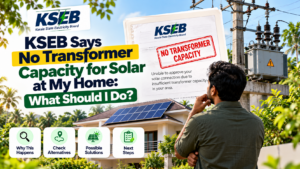
No Transformer Capacity for Solar at My Home? What Should I Do?
No transformer capacity for solar at my home is a concern many homeowners may face when checking rooftop solar feasibility through the Kerala State Electricity Board (KSEB). Even if your roof has enough space and sunlight, your proposed grid-connected solar system may not receive technical feasibility approval if the local distribution network has reached its permitted renewable-energy capacity.
The good news is that a zero balance on the transformer-capacity portal does not necessarily mean you can never install solar. Understanding the reason and checking the available options can help you decide what to do next.
What Does No Transformer Capacity for Solar at My Home Mean?
When you see no transformer capacity for solar at my home, it generally means the relevant distribution transformer has no remaining capacity shown for additional grid-connected renewable-energy systems under KSEB’s published capacity calculation.
A distribution transformer supplies electricity to homes and businesses in a particular area. When rooftop solar systems export surplus electricity to the grid, the local network must be able to accommodate that power safely.
KSEB’s official DTR Capacity portal displays transformer-wise capacity, feasibility issued, grid-connected capacity and balance available. The published calculation applies a 90% limit to the distribution transformer’s capacity for interconnected distributed energy systems under the cited regulation.
However, the portal’s balance figure is not a substitute for the formal technical assessment of your individual application.
Why Is There No Transformer Capacity for Solar at My Home?
Several factors may explain why the required capacity is unavailable.
1. The Transformer Has Reached Its Permitted Solar Capacity
When the renewable-energy capacity already allocated to a transformer reaches its applicable limit, additional grid-connected solar applications may encounter feasibility restrictions.
2. Other Solar Systems Have Already Been Approved
The capacity shown as feasibility issued may include systems that have been approved but are not yet connected. Therefore, the available balance may differ from what you would expect by counting installed solar systems alone.
3. Local Network Conditions Require Assessment
Transformer capacity is only one part of the electricity distribution network. KSEB may need to assess other technical conditions before deciding whether a proposed solar system can be connected.
To understand these requirements, read our guide on how to check KSEB solar feasibility in Kerala.
No Transformer Capacity for Solar at My Home: What Should I Do Next?
If KSEB’s portal shows no remaining capacity, follow these steps before investing in a rooftop solar system.
Step 1: Check the Correct Transformer
Visit the official KSEB DTR Capacity portal. Select your district and electrical section, then identify the relevant transformer.
If you cannot determine which transformer serves your connection, contact your local KSEB electrical section for clarification.
Step 2: Confirm the Reason With KSEB
Ask the concerned section whether the restriction is specifically due to unavailable transformer capacity or another technical issue.
Understanding the actual reason is essential before choosing an alternative solar configuration.
Step 3: Ask Whether a Network Upgrade Is Possible
If the transformer has reached its permitted capacity, ask KSEB whether transformer augmentation or another network improvement is being considered or can be requested.
An upgrade may depend on technical feasibility, utility planning, approvals and other applicable requirements. Do not assume that an upgrade will be approved or completed within a particular timeframe.
Step 4: Check Again Before Making an Investment
If additional capacity becomes available later, you may be able to explore a new application or reassessment, subject to KSEB’s applicable process.
If you are wondering, “No transformer capacity for solar at my home — should I wait or choose another system?”, first obtain clarification from KSEB and discuss your requirements with a qualified solar installer.
Can I Install Hybrid Solar if There Is No Transformer Capacity?
A hybrid solar system combines solar panels, an inverter and battery storage. Depending on its configuration, it can provide backup power during electricity interruptions.
However, a hybrid system that connects to the electricity grid is not automatically exempt from KSEB’s technical-feasibility and approval requirements.
If your concern is no transformer capacity for solar at my home, discuss the following options with a qualified installer:
-
Grid-connected hybrid system: May be unsuitable for grid connection until the relevant approvals and technical requirements are satisfied.
-
Off-grid solar system: Operates independently of the utility grid when correctly designed and installed. It requires suitable battery storage and load planning.
-
Battery-backed system: Can provide backup for selected loads or, with appropriate design, a larger portion of your home’s electricity demand.
An off-grid system may be worth evaluating if grid connectivity is unavailable. However, its cost, storage capacity, energy requirements and applicable regulations must be assessed before installation.
Learn more about choosing the right transformer capacity for your solar system.
Will KSEB Approve Solar Feasibility in the Future?
Possibly, but it cannot be guaranteed. Future availability depends on factors such as additional approved capacity, network upgrades and the technical assessment applicable at that time.
If you encounter no transformer capacity for solar at my home, keep your application details and the information provided by KSEB. Ask the electrical section what conditions would need to change for your proposed installation to be reconsidered.
Avoid purchasing equipment or beginning a grid-connected installation on the assumption that approval will be granted later.
Frequently Asked Questions
Can I install on-grid solar if my transformer has no capacity?
You should not proceed with a grid-connected installation without the required KSEB technical feasibility and approvals. Contact your electrical section to understand the restriction and possible next steps.
Does zero balance on KSEB’s portal mean solar is permanently unavailable?
No. It indicates that no balance is currently shown under the published transformer-capacity calculation. Future availability depends on network conditions and applicable approvals.
Can reducing my solar system size solve the problem?
Not necessarily. A smaller system may be worth discussing with KSEB and your installer, but it does not guarantee approval if the relevant transformer has no available capacity.
Is an off-grid solar system an alternative?
It may be suitable if you need electricity without exporting power to the grid. However, the system must be properly designed for your consumption, battery requirements and applicable regulatory conditions.
Conclusion
No transformer capacity for solar at my home can be frustrating, especially when you are ready to reduce your electricity bills. However, the best next step is to identify the correct transformer, confirm the reason for the restriction with KSEB and explore technically suitable alternatives before committing to an installation.
GSL Energy Solutions helps homeowners assess their solar requirements and understand the installation process. Contact GSL Energy for a solar consultation to discuss your electricity consumption, roof suitability and potential system options based on your circumstances.